Starting an online business can feel exciting and terrifying at the same time—especially when the risks feel personal (money, visibility, judgment, and the fear of “wasting time”). The Online Business Confidence Kickstart Bundle is designed to turn that big, scary leap into a sequence of small, doable steps that build momentum without requiring perfection on day one.
Fear doesn’t automatically mean you’re not cut out for business. More often, it’s a signal that you’re stepping into uncertainty: new skills, a new identity, and a new routine—all at once. That kind of change naturally creates friction.
Common “scared-start” triggers include being seen online, choosing a niche, charging money, tech overwhelm, and comparison. If any of those hit a nerve, it’s not a character flaw—it’s a normal response to unfamiliar territory.
Confidence usually follows action. It’s hard to think your way into certainty when everything is hypothetical. Clarity improves when real feedback replaces imagined outcomes: a conversation, a reply to a post, a first inquiry, a simple “yes, I’d pay for that.”
A supportive structure reduces decision fatigue. When you already know the next small step, progress becomes easier to repeat—and repeating progress is how nervous beginners become steady builders.
A structured bundle replaces vague motivation with a repeatable process: identify the next smallest step and complete it. Instead of asking “What should I do with my whole business?” you ask “What can I finish in 20 minutes that moves me forward?”
Planning also creates emotional safety. Fear often spikes when everything feels urgent and undefined. A simple sequence lowers the “everything at once” pressure and gives your brain a clear place to start.
Over time, small wins become a proof trail. Messages sent, offers drafted, pages published—these are tangible receipts that you can do this. You don’t have to feel confident to take action; you can collect evidence until confidence catches up.
One of the biggest shifts is learning to separate “business facts” from “fear stories.” Facts are things you can verify (pricing, deliverables, customer feedback). Fear stories are assumptions (everyone will judge me, I’ll pick wrong forever, I’ll fail publicly). Structure helps you work with facts and test stories instead of treating them as reality.
When fear is loud, the goal isn’t a perfect master plan—it’s a tiny, testable start you can sustain.
Choose one audience, one problem, and one promise. Narrow isn’t limiting; it’s calming. You can broaden later after you have traction.
Start with something you can deliver consistently: a starter service, a small digital product, or a simple package. Reliability builds confidence faster than complexity.
Pick one: an email list, a social platform, a marketplace, or a basic website. Avoid spreading attention thin—focus is what makes early effort pay off.
Outline, draft, publish, then improve. Early versions are allowed to be plain. The job is to exist, not to impress.
| Day | Focus | Small action | Time |
|---|---|---|---|
| Day 1 | Calm the overwhelm | Write the one-sentence business idea and the one person it helps | 15–20 min |
| Day 2 | Offer clarity | Draft a simple offer: outcome + who it’s for + what’s included | 20–30 min |
| Day 3 | Proof and positioning | List 3 relevant experiences or strengths that support your offer | 15 min |
| Day 4 | Visibility without spiraling | Write one helpful post or email outline (no selling required) | 20–30 min |
| Day 5 | Validation | Message 3 people with a short question about their needs (no pitch) | 15–25 min |
| Day 6 | Build the minimum asset | Create one page: a simple description + how to contact/buy | 30–45 min |
| Day 7 | Launch the first tiny test | Invite a small group to respond, join a waitlist, or book a call | 20–30 min |
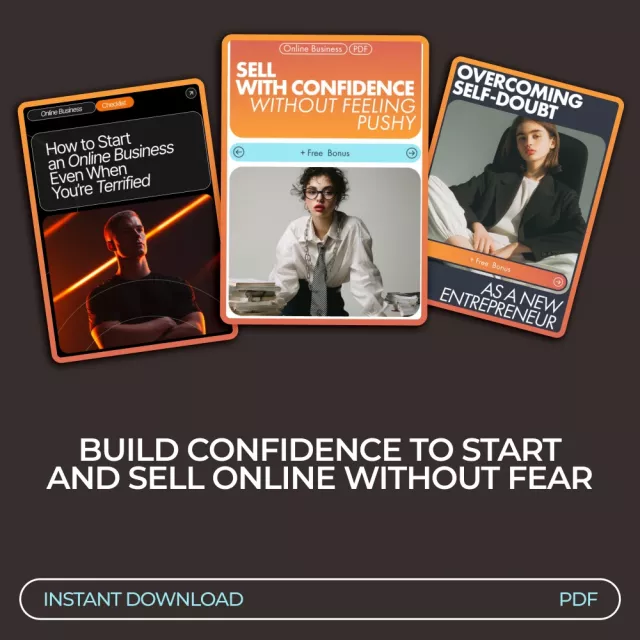
If you want a guided, gentle start, the core resource is Online Business Confidence Kickstart Bundle | How to Start an Online Business When You’re Scared. For people who also want calm structure in other parts of life (because confidence is easier when your environment supports you), these in-stock options can complement your routines:
Yes. A minimum-commitment schedule (like two short work sessions per week) works best when you focus on one offer and one primary channel, then run small tests instead of planning a big launch.
Shrink the task until it feels doable, timebox it (10–20 minutes), and separate facts from fear stories. Micro-wins—small actions completed consistently—tend to create the confidence that overthinking can’t.
No. Early sales often come from small networks, direct outreach, and clear, focused messaging, especially when you validate with real conversations and a simple page or waitlist.
If you have any questions, here are some useful links:













Leave a comment