Picky eating can look like defiance, but most of the time it’s a normal stage of development. Many kids go through a period of food neophobia—basically, a fear of unfamiliar foods—especially in early childhood. From an evolutionary standpoint, caution around “new” foods was protective. Today, it just means your child may need calm, repeated exposure before a food feels safe.
Sensory factors can also matter more than taste. Texture (mushy, slimy, stringy), temperature (too hot, too cold), mixed foods (casseroles, soups), strong smells, and even “foods touching” can be bigger barriers than flavor. On top of that, appetite naturally changes day to day—growth spurts, busy schedules, and activity level all affect how much a child wants to eat.
Finally, past pressure can leave a mark. When meals become a negotiation (“one more bite,” “just try it,” “no dessert unless…”), kids often dig in harder. The goal shifts from learning to “winning,” and nobody enjoys dinner.
A playful checklist turns a vague goal (“try broccoli”) into tiny steps that feel doable. It also makes space for autonomy: your child can choose which step they’re ready for today, and you can stay consistent and calm. Over time, the checklist helps you track exposure—because many children need multiple neutral interactions with a food before they accept it.
Most importantly, it redefines success. Looking, smelling, and touching still count. Those are real building blocks for eating, and they keep the learning process positive.
| Step | What it looks like | What to say | Why it helps |
|---|---|---|---|
| Look | Food is on the plate or nearby | “You can just look at it.” | Reduces fear through safe exposure |
| Smell | Child leans in to smell or wafts | “Smell it like a scientist.” | Builds familiarity before tasting |
| Touch | Pokes, holds, or breaks apart | “Let’s see how it feels.” | Desensitizes texture concerns |
| Taste | Licks or tiny nibble then stops | “A taste is enough.” | Lowers pressure and increases willingness |
| Chew & decide | Chews and may spit out politely | “You can decide after chewing.” | Gives control while practicing the skill |
| Swallow | Eats a bite and moves on | “Nice job trying.” | Reinforces effort, not volume |
To keep meals steady (and prevent the new food from taking over the whole table), use a simple structure: 1–2 “safe foods” your child reliably eats plus 1 “learning food.” That learning food is the new or previously refused item.
If you’d like a research-aligned framework for roles at the table, the Ellyn Satter Institute’s Division of Responsibility pairs well with the checklist approach: adults decide what and when food is served; kids decide whether and how much to eat.
The words used at the table can either lower stress or accidentally turn tasting into a test. Try neutral phrases that invite observation:
Avoid “good/bad” food labels and skip praising clean plates. Instead, praise skills: noticing, touching, tasting, chewing, or making a brave choice. And steer clear of bargaining (“If you eat this, you get dessert”), which can make the new food feel like a punishment.
For kids who love pretend play, assign fun roles: food detective, texture tester, smell scientist, or crunch reporter. A playful job often gets a hesitant child closer to the food without a showdown.
For additional general guidance on healthy eating patterns for kids, helpful starting points include HealthyChildren.org by the American Academy of Pediatrics and the CDC’s nutrition resources.
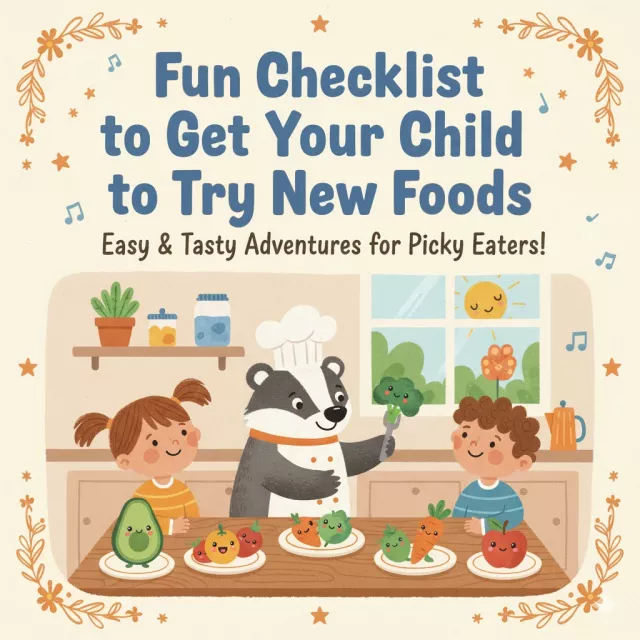
If you want a ready-to-use, kid-friendly version of the steps above, the Fun Checklist to Get Your Child to Try New Foods printable Kids Mealtime Guide lays out the exposure ladder in a simple format kids can follow. It’s designed to reduce negotiations and keep progress visible—even when the win is “smelled it” or “touched it.”
For families who want extra support around staying calm and consistent (especially during tough stretches), a mindset tool can be helpful alongside the mealtime routine. The Think Happy: Affirmations Pack can be used as a quick reset before dinner or after a hard meal, so everyone returns to the table with less tension.
Many kids need repeated, low-pressure exposure before acceptance, and “trying” can start with looking, smelling, or touching. The number varies by child and by food, but consistency over weeks matters more than pushing extra bites in one meal.
Use a separate “learning plate” or place the food on the table nearby so it’s present without feeling intrusive. Keep the portion tiny and let your child choose the checklist step (even “look” is a valid start).
Using dessert as leverage often increases pressure and can make the new food feel like a hurdle. A calmer approach is to keep dessert occasional and predictable, and praise curiosity and effort rather than the amount eaten.
If you have any questions, here are some useful links:












Leave a comment