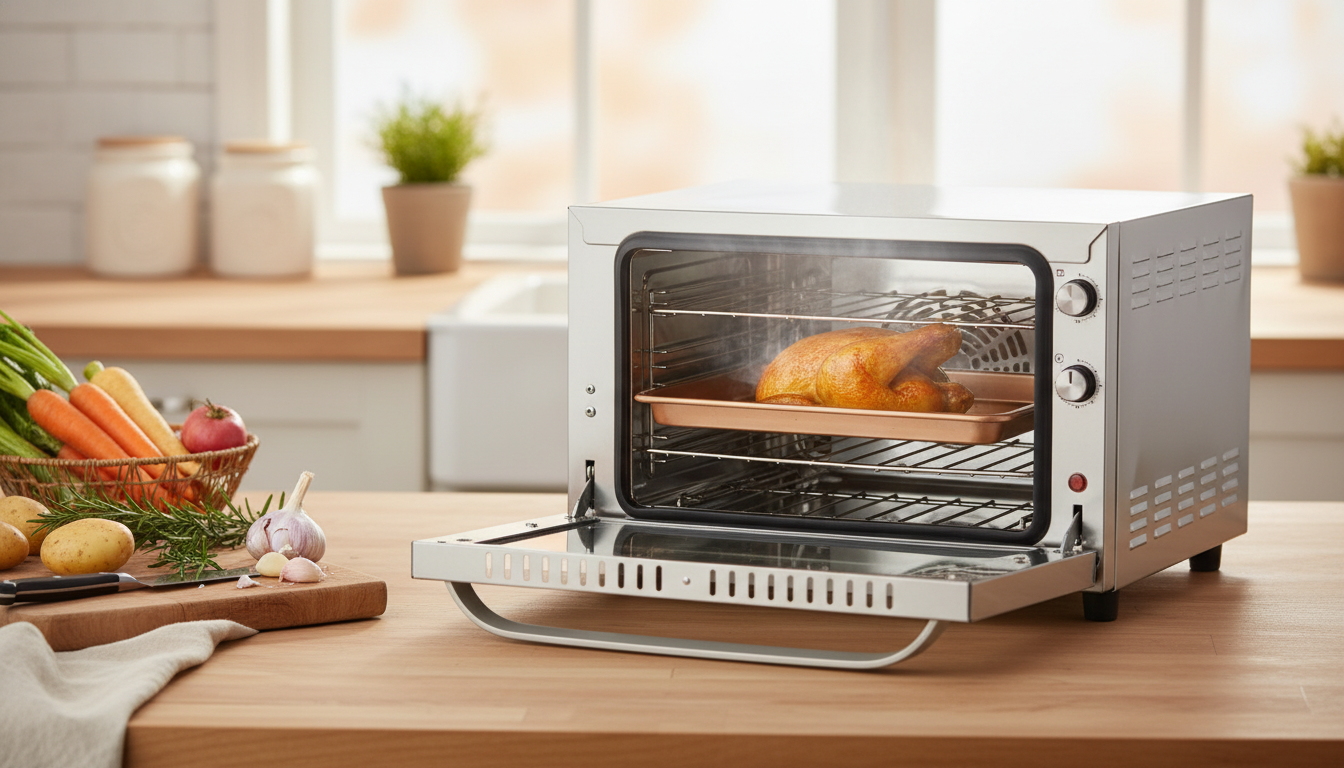
A countertop convection oven built for consistent heat circulation and efficient multi-tray baking can simplify everyday meals and batch bakes. This 21L/47L/66L electric convection oven is designed to handle everything from quick reheats to multi-layer baking sessions while keeping results evenly browned and predictable.
Convection cooking uses a fan to circulate hot air throughout the cavity. That steady airflow helps reduce hot spots, supports more uniform browning, and improves consistency across the entire cooking chamber—especially compared to still-air heating where the top rack can behave differently than the bottom.
For bakers, the biggest payoff is even heat distribution across multiple trays. Cookies, pastries, and sheet-pan snacks tend to brown more consistently when hot air moves around (not just over) the food. It also makes a countertop unit a practical way to add extra oven capacity without remodeling—useful in small kitchens, dorm-style setups, and as an overflow oven during holiday cooking.
Because the cavity is smaller than a full-size range, a dedicated countertop convection oven can also reduce preheat and temperature recovery time after the door opens. That can matter when you’re loading several trays or checking doneness frequently.
Capacity determines what pans fit, how many racks you can use comfortably, and how well air can circulate around crowded loads.
Before choosing, measure counter space, door swing clearance, and ventilation room around the unit. If multi-layer baking is a priority, pick the capacity that lets you load trays without blocking airflow—tight fits can lead to pale centers and over-browned edges.
| Capacity | Typical best for | Multi-layer advantage | Countertop considerations |
|---|---|---|---|
| 21L | Small meals, reheating, single-tray baking | Good for 1–2 trays depending on tray size | Most compact footprint; easiest to store |
| 47L | Family meals, larger pans, frequent baking | More flexibility for 2–3 trays | Needs more clearance; check cabinet height |
| 66L | Batch baking, entertaining, high-volume prep | Best for 3–4 layer baking workflows | Largest footprint; plan dedicated counter space |
Multi-tray baking is where convection shines, but technique still matters. When you fill multiple racks, the oven works harder to push hot air around pans, food, and rack rails.
For food safety, rely on tested guidance for minimum internal temperatures when cooking meat and poultry. The USDA’s food safety resources are a strong reference for safe handling and doneness standards: USDA Food Safety and Inspection Service — Cooking and Food Safety.
A countertop convection oven can handle a wide range of daily tasks while also pulling double duty for batch work.
For general consumer food safety tips—especially around storage and reheating practices—the FDA’s consumer guidance is a useful companion reference: FDA — Food Safety for Consumers.
Consistency comes from treating a countertop convection oven like a “small but real oven,” not a casual toaster replacement.
For multi-layer baking in a dedicated countertop format, the Electric Convection Oven, 21L/47L/66L, Countertop 3-4 Layer Baking Machine is available in multiple capacities to match different kitchen sizes and baking volumes. Choose the size that fits your typical tray and pan dimensions while still leaving room for airflow around each rack.
Yes. Convection airflow supports multi-tray baking, but best results come from leaving space for air circulation, rotating trays partway through, and avoiding overcrowding.
Often, convection can cook faster or brown more quickly. Many recipes work with a small temperature reduction or a shorter bake time, so it helps to start checking doneness early.
Larger capacities generally provide more rack space and airflow room. For frequent multi-layer baking, the largest option is typically the most comfortable fit.
If you have any questions, here are some useful links:










Leave a comment