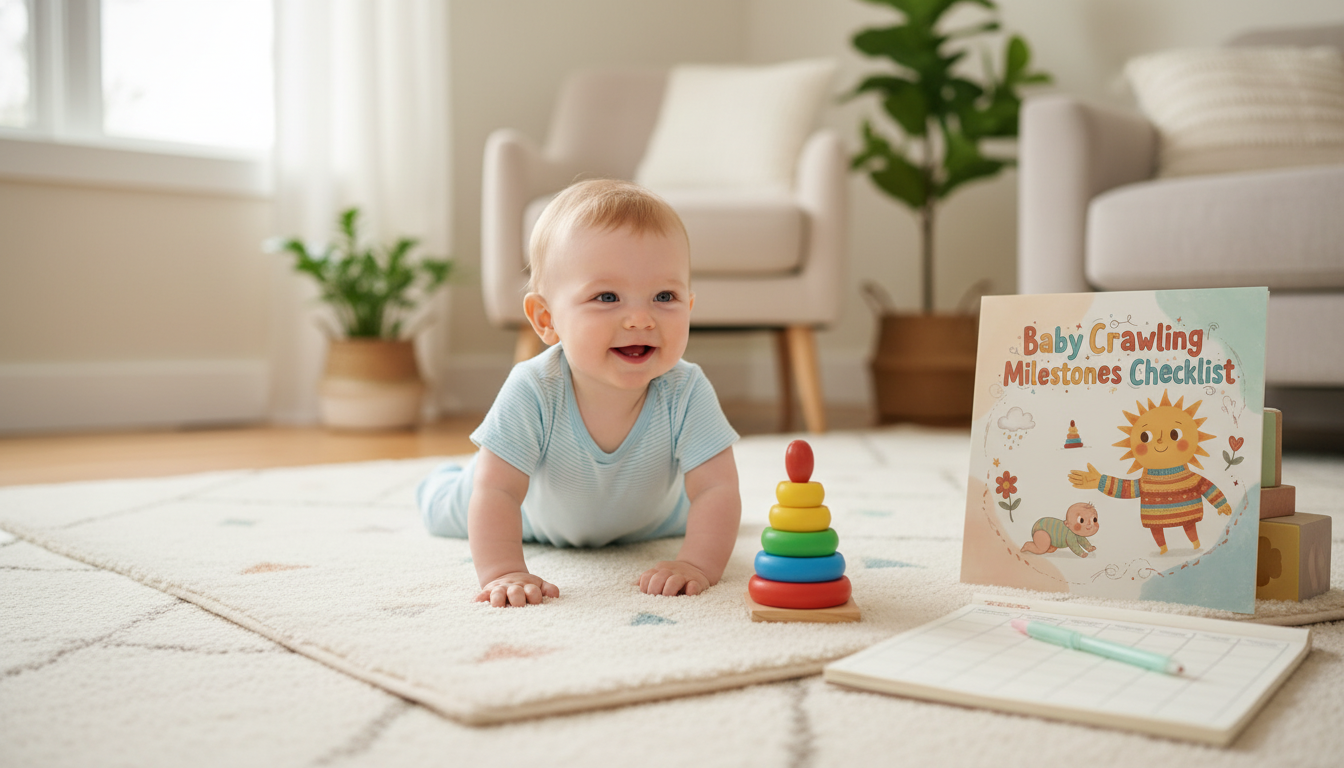
Crawling is one of the first big mobility milestones, but it often arrives in a wide range of “normal.” Some babies crawl early, some later, and some skip traditional crawling patterns altogether. A simple checklist and tracker can help spot progress (strength, coordination, confidence) without turning development into a race—and can make it easier to share clear notes with a pediatrician if questions come up.
Crawling isn’t one single skill so much as a group of ways a baby learns to move their body through space. The classic version is hands-and-knees crawling: baby supports weight on hands and knees and moves forward with alternating limbs.
Many other patterns are common and can still build strong foundations:
It can be typical to pause, switch styles, or even crawl backward before moving forward. And “not crawling yet” is not automatically a problem if other skills are developing, such as steady head control, pushing up, pivoting, reaching, and weight shifting.
Many babies begin some form of mobility between about 6 and 10 months, with wide individual variation. Earlier building blocks usually show up first: better tummy time tolerance, pushing up on straight arms, pivoting in a circle, and rocking on hands and knees.
Some babies skip crawling and move to pulling to stand and cruising. That can still be normal when overall strength and coordination keep progressing. If your baby was born prematurely, milestones are often tracked using adjusted age. Try to look for change over weeks rather than day-to-day shifts.
For broad developmental guidance, these resources can be helpful when paired with your pediatrician’s advice: CDC developmental milestones and American Academy of Pediatrics (HealthyChildren.org).
Instead of focusing on one “start date,” watch for clusters of readiness skills:
Consider tracking skills as emerging, getting consistent, and confident rather than a strict yes/no. Progress often shows up across multiple areas—strength, balance, coordination, and endurance—and it may be uneven for a while.
If something feels stalled, try short daily practice bursts and reassess after 2–3 weeks.
| Age range (approx.) | Skills that often appear | What to try at home | Notes to track |
|---|---|---|---|
| 3–4 months | Tummy time tolerance increases; pushes up on forearms; turns head both ways | Short, frequent tummy time sessions; place toys slightly to the side to encourage reaching | Minutes of tummy time; symmetry (left/right) |
| 4–6 months | Pushes up on hands; pivots on tummy; rolls both directions | Toy “arc” to encourage pivoting; encourage rolling with gentle prompting | Rolling ease; pushing up with straight arms |
| 6–8 months | Sits with less support; rocks on hands-and-knees; may start army crawling | Hands-and-knees rocking over a rolled towel under belly; place toy just out of reach | Rocking duration; attempts to move forward |
| 8–10 months | Crawls on hands-and-knees or continues a variant; transitions between sitting and crawling | Obstacle course with pillows; “tunnel” play; motivate with a favorite safe object | Distance traveled; ability to change direction |
| 10–12 months | Crawling becomes efficient; pulls to stand; cruises along furniture | Cruising practice with stable furniture; safe floor space for exploration | Pull-to-stand attempts; confidence level |
Tummy time supports the strength and coordination babies use for rolling, pivoting, and crawling. What matters most is consistency, not marathon sessions. Multiple short sessions are often easier and just as effective.
Bringing simple notes from a checklist and tracker can make the conversation clearer and more specific. For additional general tips, you can also reference the NHS baby development guidance.
Yes. Some babies use alternate mobility (army crawling, scooting, rolling) or move straight to pulling to stand and cruising. If overall strength, coordination, and skill progression look steady, skipping traditional crawling can be typical—bring concerns to a pediatrician if multiple milestones seem delayed.
Frequent short sessions tend to work best, building tolerance gradually while focusing on quality (pushing up, reaching, weight shifting). Use supervised variations—floor, chest-to-chest, or over a firm cushion—and adjust based on your baby’s comfort and age.
Common cues include rocking on hands-and-knees, pivoting on the tummy, stronger weight shifting, reaching without collapsing, and moving backward before figuring out forward motion. Strong motivation to reach a toy or caregiver often shows up right before a mobility jump.
If you have any questions, here are some useful links:










Leave a comment