
A 50mm F0.95 manual lens is built for photographers who want maximum background separation, a distinctive look wide open, and strong low-light capability on APS-C and Micro Four Thirds bodies. With manual focus and a very large aperture, it rewards careful technique—especially for portraits, street scenes at night, and detail shots where subject isolation matters most.
Opening up to F0.95 reshapes the entire portrait experience: the background melts away, the subject “pops,” and available light becomes far more usable. That comes with a tradeoff—depth of field is razor-thin—so technique matters as much as gear.
For a deeper refresher on how aperture influences depth of field, Cambridge in Colour has a clear explainer on depth of field.
The same 50mm focal length “feels” different depending on sensor size. On APS-C it’s a classic portrait perspective; on Micro Four Thirds it becomes tighter, which can be gorgeous for headshots but more demanding indoors.
| Camera type | Approx. full-frame equivalent field of view | Typical portrait use | Space needed |
|---|---|---|---|
| APS-C (1.5x) | ≈75mm | Headshots, half-body, street portraits | Moderate |
| Micro Four Thirds (2x) | ≈100mm | Headshots, tight candids, detail portrait work | More space |
If you shoot Micro Four Thirds, it can help to understand the system basics and standardization behind mounts and bodies at the Micro Four Thirds System site.
Manual focus at F0.95 isn’t about speed—it’s about repeatability. The best workflow leans on your camera’s focus aids and a steady, intentional shooting rhythm.
A practical portrait habit: focus, gently rock forward/back a few millimeters while watching the eye snap into peak sharpness, then fire a short burst. That micro-movement often beats repeatedly turning the focus ring when the subject is breathing or swaying.
Ultra-fast lenses are often chosen for their look as much as their specs. Wide open, many F0.95 designs emphasize atmosphere—soft transitions, luminous highlights, and a sense of depth—then become more crisp and contrasty as you stop down.
If you’re curious about what the F-number physically represents (and why it impacts exposure), see the overview on F-number.
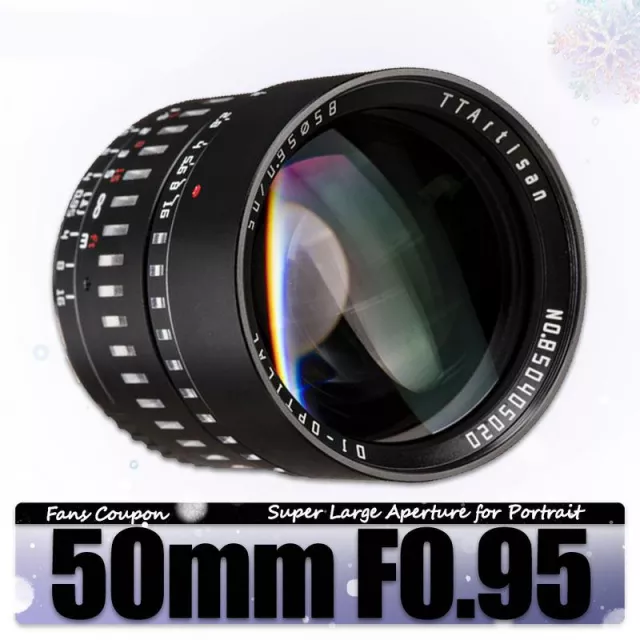
For photographers ready to lean into the wide-open look, the 50mm F0.95 Large Aperture Manual Portrait Lens for APS-C and M43 Cameras is designed to deliver pronounced background blur and strong subject separation with a fully manual, hands-on feel.
| Item | Details |
|---|---|
| Product | 50mm F0.95 Large Aperture Manual Portrait Lens for APS-C and M43 Cameras |
| Price | 538.49 USD |
| Availability | In stock |
It can be challenging because depth of field is extremely thin, but it’s very manageable with EVF magnification or focus peaking, a steady shooting stance, and short bursts. When consistency matters more than maximum blur, stopping down to around F1.4–F2 noticeably improves the hit rate.
Yes—on Micro Four Thirds it frames like roughly a 100mm equivalent, which is excellent for headshots and compressed, flattering perspective. It does require more working distance, so indoor portraits can feel tight unless you have space to step back.
In bright conditions, an ND filter is often necessary if you want to stay at F0.95 without exceeding your camera’s shutter speed limits or overexposing. A variable ND offers flexibility, while a fixed ND can be a simple, consistent choice for predictable lighting.
If you have any questions, here are some useful links:












Leave a comment